
FUE Hair Transplants
For a precise, painless, scarless hair transplant
Up until recently, the hair transplant was a heavy and painful procedure with mediocre results, leaving ugly scars.
But today, with research and technical advances, hair transplants are a more effective, high-performance and less invasive alternative.
This innovative capillary micrograft technique treats alopecia in the long-term, with natural-looking results which are painless and scarless.
Performed with high-precision materials, this technique consists first of extracting hairs from the nape (donor area) where hair mass is generally dense and particularly resistant.

The Procedure: Step by Step
Prior to the Procedure:
A preliminary appointment with Dr Sebbah Simon is necessary to assure you meet the procedure requirements, to explain the process, while eliminating the possibility of treating the alopecia via hair loss medications.
The doctor then determines the number of hairs to be reimplanted and the treatment area(s) with the patient.
During the Procedure:
The procedure is performed using a local anesthesia. The hairs are extracted from the previously shaven donor area, and then reimplanted into the recipient area(s).
This procedure lasts anywhere from 3-8 hours, depending on the number of hairs to reimplant.
Post-Procedure:
Following the procedure, the patient must respect a 5-7 day recovery period to optimize the setting of the grafted hairs and complete the healing process.
A post- surgical protocol is equally prescribed to the patient and a follow-up is scheduled.
The results are progressive and become definitive 9-12 months following the hair transplant.
As of the 7th day following the procedure, scabs which formed on the extraction zone and around the transplanted hairs will disappear.
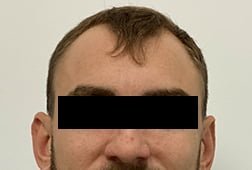
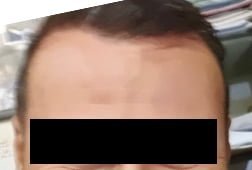
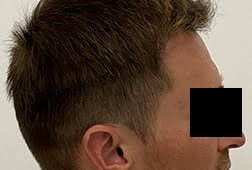
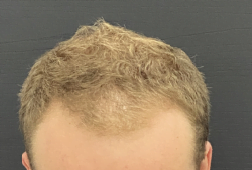
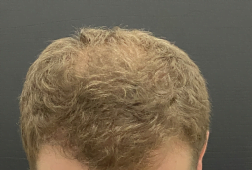
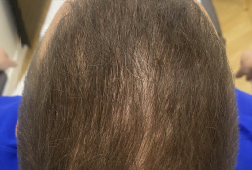
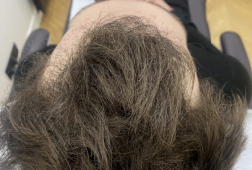
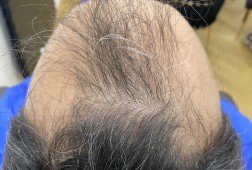
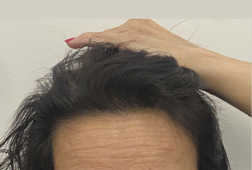
Before & After









FAQs
Answers to frequently asked questions about the FUE Hair Transplants
+ - What are the contraindications?
This treatment is contraindicated in the following cases:
- Ongoing infectious diseases
- Blood clotting disorders
- Autoimmune conditions
+ - Is there a season to favour?
Contrary to popular belief, there is no "best season" for a hair transplant: hair grows back the same way in summer or winter. However, the choice of timing has a practical benefit. We generally recommend autumn or winter, for two reasons: the grafted scalp must be protected from direct sun for several weeks, which is easier outside the summer months, and the post-operative scabs and redness, visible for about ten days, are easier to conceal under a hat in winter than in the height of summer.
+ - Why is there such a price gap between France and abroad?
This is probably the most frequently asked question. A hair transplant in France generally costs between €4,000 and €10,000 depending on the number of grafts, compared to €1,500 to €3,000 in countries such as Turkey. This gap is explained by several factors: the cost of medical and paramedical labour, social security and tax charges, and the level of regulation. In France, the procedure is strictly regulated and carried out by a doctor, which means a smaller team and personalised follow-up. Abroad, some clinics operate on a very high-volume model, with non-medical technicians carrying out part of the implantation under the supervision of a single practitioner for several patients simultaneously, a practice banned in France.
In addition, there is generally no follow-up abroad, which is not the case at the Doctor and Co clinic, where each patient is seen again by the doctor at 1 month, 6 months and 1 year post-procedure.
+ - What are the risks?
Like any procedure, a hair transplant is not without risk, although serious complications remain rare. The most common effects are temporary: swelling of the forehead or scalp, scabs, mild pain or numbness, redness. More serious, though less frequent, risks exist: infection of the operated area, follicular cysts, visible scarring (particularly with the FUT technique), or "telogen effluvium", a temporary shedding of existing hair caused by the shock of the procedure, generally reversible within a few months. The most feared risk remains partial failure of regrowth, linked to poor handling of the grafts, excessive density demanded from an overused donor area, or the patient not following post-operative recommendations.
+ - At what age can you get a hair transplant?
The youngest patients may be 20-25 years old, though we advise against a transplant before 25-30. The reason is simple: baldness is often still progressing at that age, and it is difficult to predict the future extent of hair loss. Transplanting too early risks an inharmonious result a few years later, as hair loss continues around the transplanted area. There is, however, no strict maximum age limit: what matters is general health and the quality of the donor area at the back of the scalp, which generally remains preserved even in older men.
+ - What is the success rate?
When carried out by an experienced team, a hair transplant shows a graft survival rate generally estimated at between 90 and 95%. This figure varies, however, depending on the technique used, the practitioner's experience, how well the grafts were preserved during the procedure, and the patient's compliance with post-operative instructions. A poorly performed transplant, particularly when grafts remain outside the scalp for too long or are extracted carelessly, can see this rate drop significantly.
+ - What harvesting and reimplantation techniques exist today?
Two main families of harvesting techniques coexist:
- FUE (Follicular Unit Extraction): each follicle is individually removed using a micro-punch, leaving no linear scar. This is the most widespread technique today, as it is less invasive and requires no stitches.
- FUT (Follicular Unit Transplantation), or strip technique: a strip of scalp is removed and then dissected into follicular units. It allows more grafts to be harvested in a single session, but leaves a linear scar at the back of the scalp.
For reimplantation, several methods also exist: classic implantation after creating micro-incisions, also known as the sapphire blade technique, or the DHI (Direct Hair Implantation) technique, which uses an implanter pen to insert the graft directly.
Both techniques are valid and are used together or on their own depending on the thickness of the scalp and of the hair or grafts harvested.
+ - How do you choose the right technique?
The choice depends on several criteria: the extent of baldness, the quality and elasticity of the scalp, the number of grafts needed, and the patient's aesthetic expectations. FUE is generally preferred for small to medium areas, or when the patient wants to be able to wear very short hair without a visible scar. FUT is sometimes still indicated for extensive baldness requiring a very high number of grafts in a single session. In all cases, this choice must be made during a thorough medical consultation, based on a precise diagnosis of the type of alopecia.
+ - Transplants and scalp conditions: psoriasis, seborrheic dermatitis, ringworm
The presence of an active dermatological condition is generally a temporary contraindication to a transplant. A flare-up of psoriasis or seborrheic dermatitis can weaken the scalp, increase the risk of infection and compromise graft healing. Ringworm, a contagious fungal infection, must be treated and fully resolved before any procedure. In most cases, these conditions are not permanent contraindications: prior dermatological treatment, followed by a period of stabilisation, then allows the transplant to be considered safely.
+ - Can you transplant onto a scar?
Yes, transplanting hair onto scar tissue is a common practice, whether the scars are traumatic, post-facelift or post-forehead lift. Grafts can be implanted directly into the scar tissue to camouflage its trace. The result, however, depends on the quality of the scar's blood supply: an older, well-vascularised scar generally offers a better survival rate than a recent or very fibrous one.
+ - Can you transplant onto a mole?
No: areas with moles (nevi) must be avoided when designing the implantation line. Grafts are never inserted directly into a nevus, both to avoid damaging it and to allow it to continue being monitored over time, as a suspicious mole hidden by hair is harder to examine if it changes in size, shape or colour.
+ - What are the recommendations after the procedure?
Post-operative instructions are crucial to the success of the transplant. They generally include: avoiding touching or scratching the scalp during the first few days, sleeping with the head elevated for about a week using a travel pillow, avoiding intense physical exertion for 2 weeks, protecting the area from direct sun, and following a gentle washing protocol prescribed by the clinic, usually starting from day 3 or 4.
+ - Are the effects of a hair transplant permanent?
Transplanted hair comes from follicles harvested from an area genetically resistant to hair loss (usually the back of the scalp). Once regrown, they generally retain this resistance and are therefore considered permanent. This does not mean, however, that non-transplanted hair around the treated area will stop falling out: a transplant does not stop the natural progression of baldness on the rest of the scalp, which is why some patients combine the procedure with a medical treatment that slows hair loss (finasteride, minoxidil).
+ - Hair transplants: past, present and future
The technique dates back to the 1950s, with the first large-diameter "punch" grafts, which gave an unnatural, tufted result. The 1990s saw the rise of FUT and follicular units, before FUE became dominant in the 2000s-2010s thanks to the miniaturisation of instruments. Today, research is moving towards automation (AI-assisted harvesting robots) and, above all, towards hair cloning, i.e. the laboratory multiplication of hair follicles from a limited number of samples. This avenue, still at the experimental stage, could eventually overcome the limit on the number of grafts available from the donor area.
+ - Where do things stand with hair transplants in women?
Long seen as a male procedure, hair transplants are growing significantly among women, where alopecia most often takes a diffuse form (general thinning) rather than a localised one, making diagnosis and indication more complex. A transplant is not systematically suited to this type of alopecia and requires a prior hormonal assessment to rule out other causes (deficiency, thyroid issues, female pattern hair loss). Where the indication is confirmed, particularly in cases of localised recession of the frontal hairline, the techniques used are the same as for men.
+ - When do you see results?
Regrowth follows a fairly precise timeline. After the procedure, most of the transplanted hair shafts fall out between weeks 3 and 6, a normal phenomenon known as "post-transplant shedding", which does not signal failure since the root of the transplanted hair remains active under the skin. It just needs a little time to settle into its new home. Visible regrowth generally begins between months 3 and 4, with a still-partial result. The final result, in terms of density and texture, is usually assessed between 10 and 14 months after the operation.
+ - How long before I can play sport again?
Light physical activity can generally resume after about ten days, but intense sport, particularly anything causing heavy sweating or a risk of impact to the scalp, is not recommended for 3 to 4 weeks, until the grafts are firmly anchored.
+ - How long before I can resume a normal social life?
The most visible scabs and redness generally fade within about ten days. Most patients return to work and social activities one week after the procedure, possibly concealing the area with a loose cap during the first few days.
+ - Can I wear a cap, a helmet or a hat?
It is generally advised against wearing any headwear during the first week, until the grafts are well fixed and the scalp swelling has gone down. A loose-fitting cap that doesn't directly touch the transplanted area may be tolerated after 1 week. Wearing a helmet (motorcycle, bicycle) is generally postponed for 2 to 3 weeks, to avoid any pressure or friction on the still-fragile grafts.
+ - How does a hair transplant actually take place?
The procedure is carried out under local anaesthesia and generally lasts between 4 and 8 hours depending on the number of grafts to be reimplanted. It is broken down into several stages: consultation and design of the implantation line, anaesthesia of the donor area, harvesting of the grafts (FUE or FUT), sorting and storage of the follicles in a suitable solution, anaesthesia of the recipient area, creation of the micro-incisions, then implantation graft by graft. The patient remains awake throughout the procedure and can go home the same day.
+ - How is the number of hairs to be transplanted determined?
The number of grafts needed depends on the area to be covered, the desired initial density, and the quantity of grafts available in the donor area, which is itself limited to preserve its natural appearance. An experienced practitioner assesses this number during the consultation, sometimes using a magnifying camera to measure existing follicular density. They also take into account the likely progression of baldness, so as not to exhaust the donor area in the first session if a second procedure may be considered in the future.
+ - What are the alternatives to a transplant?
For people who do not wish to or cannot undergo surgery, several options exist: medications (minoxidil, finasteride) that slow hair loss without fully stopping it or creating new hair, scalp micropigmentation, which visually simulates density through a tattoo-like effect, hair mesotherapy (injecting vitamins directly into the scalp), PRP (platelet-rich plasma) used for hair stimulation, or hair prostheses. These solutions can also be combined with a transplant, either beforehand to slow hair loss around the transplanted area, or as an aesthetic complement.
+ - How do you choose the right clinic?
This is probably the most decisive factor for the success of the procedure. Criteria to check include: the presence of a qualified doctor who actually performs or supervises the procedure (not only technicians), transparency about the technique used and the number of grafts planned, the possibility of genuine post-operative follow-up, and verifiable reviews and results over time, ideally at one year, when the final result is visible.
Our Prices
Prices vary according to the number of hairs to reimplant.
A customized estimate is formulated for each patient during the first appointment.
Learn more about FUE Hair Transplants...
Please don’t hesitate to contact us for all questions or click here to make an appointment with Dr Simon Sebbah.